Overview
Helping a staffing organization unify workforce, payroll, attendance, and financial data from dozens of disconnected enterprise systems.
Industry
Staffing & Workforce Management
Offering
Enterprise System Integration & Workforce Data Unification
The Challenge
A large employment and staffing organization manages thousands of workers across multiple client businesses operating in industries including logistics, retail, manufacturing, and commercial services.
Each client maintained its own technology stack. Some relied on modern cloud-based workforce platforms, while others continued to operate legacy on-premise HR, payroll, and attendance systems.
As the agency grew, so did the complexity of consolidating operational data required for payroll, invoicing, compliance, and reporting.
They needed a reliable integration platform that could connect every system without forcing clients to replace the software they already depended on.
Actinode designed and delivered a scalable integration architecture that unified data from multiple enterprise applications into a single operational platform.
The organization faced several operational challenges:
- Workforce information existed across numerous independent systems.
- Attendance, payroll, HR records, and financial data followed different structures and formats.
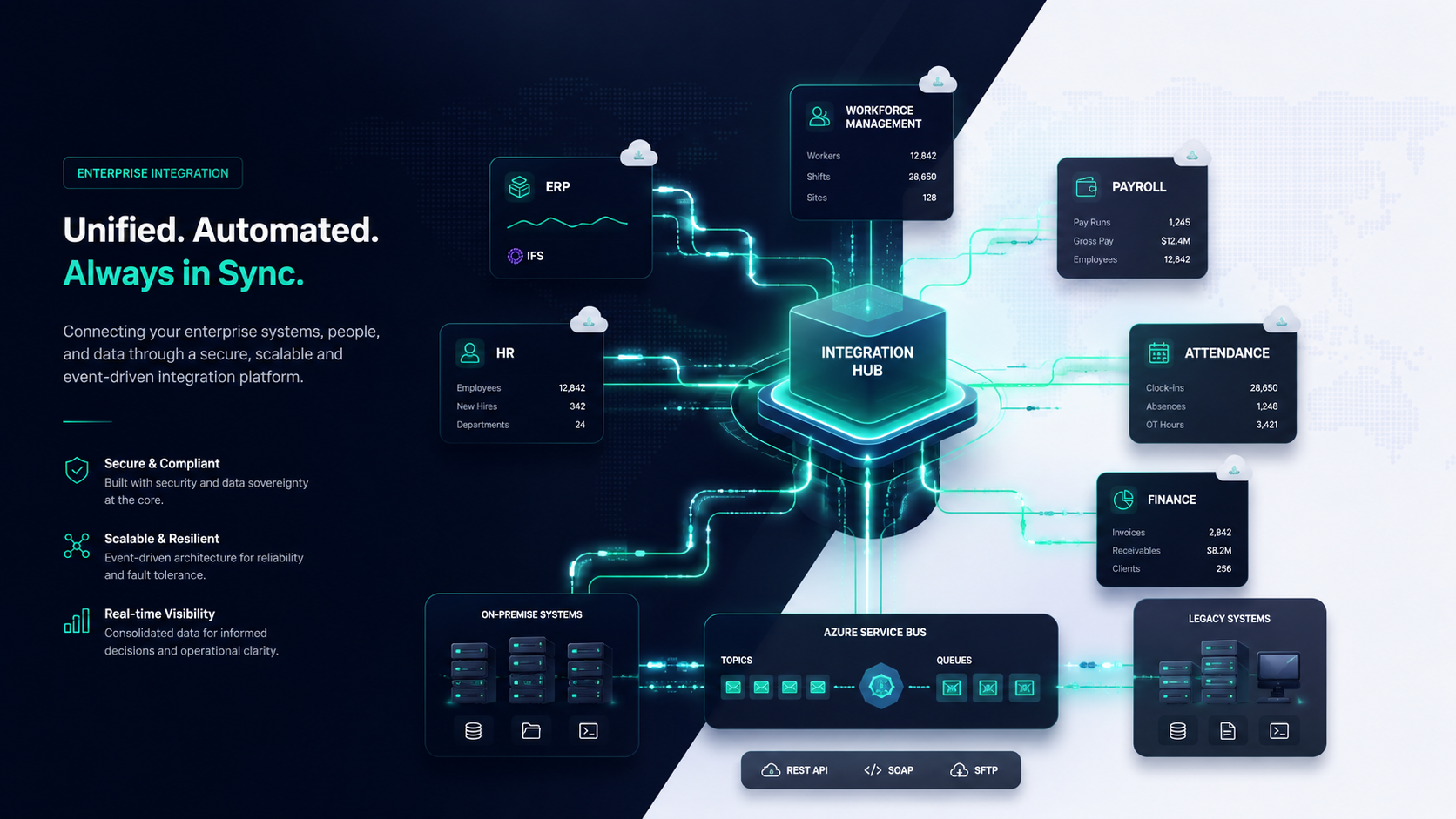
- Some integrations required modern REST APIs while others depended on SOAP services or scheduled file exchanges.
- Cloud applications had to communicate seamlessly with on-premise infrastructure.
- Billing accuracy depended on timely synchronization of workforce data.
- Manual reconciliation delayed reporting and increased operational overhead.
Instead of a single integration, this required building an ecosystem capable of supporting multiple technologies, protocols, and deployment models simultaneously.
Our Solution
Rather than creating point-to-point integrations, we designed an event-driven architecture built around reliability and long-term maintainability.
The platform was engineered to support:
- Multiple workforce management platforms
- HR systems
- Payroll applications
- ERP platforms including IFS
- Both cloud-hosted and on-premise enterprise software
Depending on each source system, integrations were implemented using:
- REST APIs
- SOAP Web Services
- Scheduled SFTP file transfers
To ensure dependable communication between services, Azure Service Bus queues and topics handled asynchronous processing, retries, and message routing, allowing individual systems to remain loosely coupled while maintaining reliable data flow.
Implementation
1. Enterprise Integration
Multi-system data synchronization, ERP integration (IFS), workforce management integration, payroll synchronization, attendance consolidation, and HR data integration.
2. Integration Technologies
REST APIs, SOAP Web Services, SFTP batch processing, Azure Service Bus, and queue and topic based messaging.
3. Deployment Environment
Cloud SaaS platforms, on-premise enterprise software, and hybrid infrastructure.
Results & Impact
- The delivered platform established a single, trusted source of operational data across previously disconnected enterprise systems
- Centralized workforce visibility
- Consistent payroll and attendance synchronization
- Improved invoicing accuracy
- Reduced manual reconciliation
- A scalable integration foundation for onboarding future client systems
- A reliable architecture capable of supporting mixed cloud and on-premise environments
Actinode Solution Approach
Enterprise integrations rarely fail because of APIs—they fail because every organization uses different systems, different data models, and different operational processes.
Our approach focuses on designing resilient integration architectures that bridge those differences while remaining secure, maintainable, and ready to scale as the business grows.
Technologies Used
Conclusion
Most importantly, the integration layer was designed to evolve alongside the client's technology landscape, allowing new systems to be incorporated without redesigning the entire platform.
Have a similar project in mind?
Let's discuss how we can help you achieve similar results for your business.